
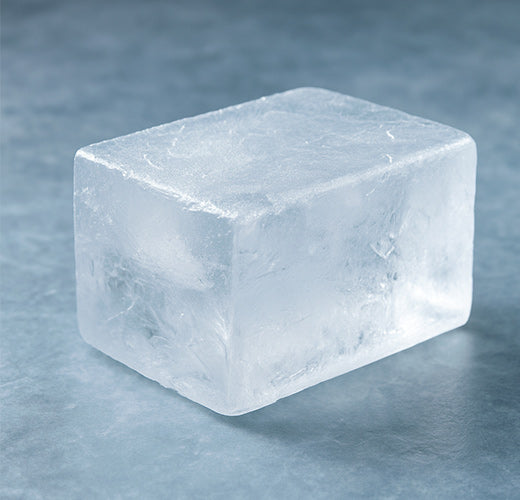
❄️ How to Freeze and Temper the Ice for Perfect Kakigori
in short
- Block ice only: Solid block ice produces soft, fluffy shavings. Compressed or cube ice does not.
- Freeze slowly: 3 to 5 days at -12 to -15C. Leave 1cm of headroom in the mold for expansion.
- Temper before shaving: 10-20 minutes at room temperature. The surface should look slightly glossy.
- Why it matters: Over-cold ice produces dry, powdery flakes. Tempered ice absorbs syrup properly.
- Serve immediately: Kakigori does not wait. Make it, hand it over, eat it.
The most common reason kakigori does not shave properly at home or in a new shop has nothing to do with the machine. It has to do with the ice going into it. Temperature and ice structure account for more of the final texture than blade type, syrup choice, or anything else in the process. This guide covers both in detail.
Block ice vs. everything else
Kakigori requires solid block ice. Not cube ice, not compressed ice made from reconstituted chips, not ice scraped from the walls of a freezer. The internal crystal structure of a slowly and uniformly frozen block is what allows the blade to shave continuous overlapping layers rather than breaking along fault lines and producing chips.
Compressed ice breaks at its seams during shaving. The result is coarser than block ice regardless of blade sharpness, and it dulls the blade faster. If you are shaving compressed ice and getting disappointing texture, the ice is the problem, not the machine.
Freezing your own blocks
Use clean water. Filtered or mineral water produces clearer, denser ice than tap water in most regions. Fill your mold to about 1cm from the top: water expands as it freezes, and overfilling cracks the mold or produces a block that does not fit the machine cleanly.
Freeze at -12 to -15C for 3 to 5 days. This slow freeze produces a denser, more uniform block than a quick freeze at a lower temperature, which creates internal stress and clouding. Do not rush it. If your freezer only goes to -18C, the ice will still work: just plan for longer tempering time before shaving.
For commercial operations: calculate your daily block usage and keep 3 to 5 times that number in reserve. If you use 10 blocks a day, you need 30 to 50 in stock at all times. Running out mid-service is a solved problem if you plan the rotation correctly.

Tempering: the step most people skip
Freshly frozen block ice is too dense and too cold to shave optimally. The blade encounters maximum resistance, producing dry flakes that do not pack or absorb syrup well. Tempering, allowing the block to warm slightly at the surface, changes the shaving behavior significantly.
Remove the block from the freezer and leave it at room temperature for 10 to 20 minutes. The indicator is visual: when the surface transitions from opaque-white to slightly translucent and develops a faint gloss or sweat, the block is ready. The outer millimetre or two of ice has softened to the point where the blade glides rather than bites.
Tempered ice produces moist, snow-like flakes that compress lightly under the syrup pour and hold their shape in the cup. It also reduces blade wear. On a machine used heavily, the difference in blade life between consistently tempered and consistently under-tempered ice is measurable across a season.
Quick reference
| Step | What to do |
|---|---|
| Ice type | Solid block only. No compressed or cube ice. |
| Water | Filtered or mineral. Fill mold 1cm from top. |
| Freeze time | 3-5 days at -12 to -15C |
| Temper time | 10-20 minutes at room temperature |
| Ready signal | Surface looks slightly glossy or sweating |
| Stock level | 3-5x daily usage kept in reserve |
See our full kakigori machine range, both manual and electric, and our accessories and supplies including molds and replacement blades.